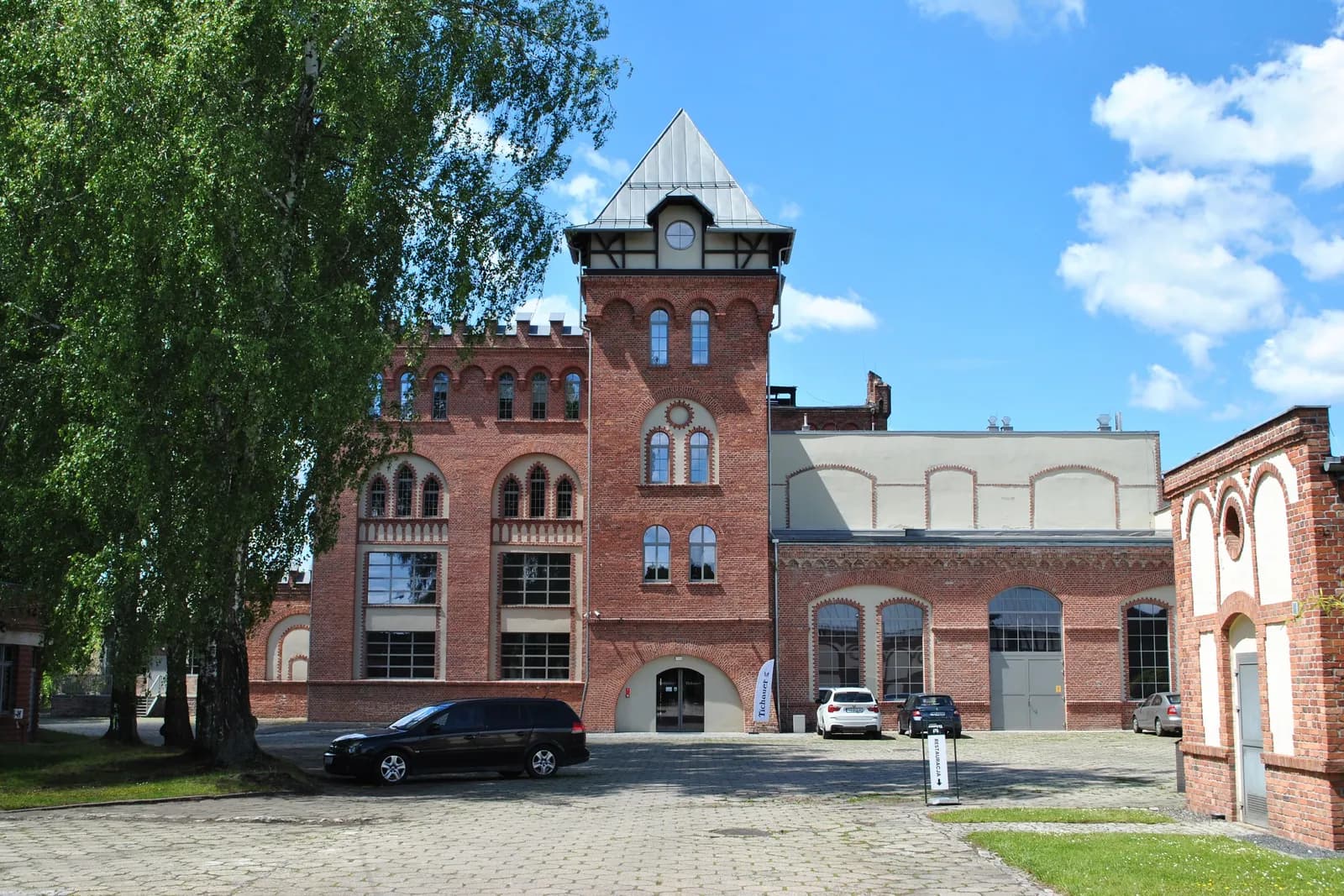
Places built for industry can outlive their original purpose, but their buildings often retain the character that makes them worth returning to.
West of the railway platforms in Tychy, a collection of historic industrial buildings tells a story that has changed considerably since the first beer was brewed there in the late nineteenth century. What was once Browar Obywatelski is now Tichauer Browar Obywatelski, a creative complex where culture, hospitality, business and events occupy a site shaped by more than a century of industrial activity.
The transformation is significant because the brewery has not simply disappeared from the story of the place. Its architecture and industrial character provide the setting for what happens there today, giving the complex an identity that could not easily be recreated elsewhere.
An industrial site with a long memory
The story began in 1895, when the Citizens' Brewery, known in German as Brieger Brauerei Aktien Gesellschaft, was established west of Tychy's railway station. Brewing quickly became an important part of the site, and the brewery entered into an agreement with its much larger neighbour, Browar Książęcy, as early as 1896.
Ownership and organisation changed over subsequent decades. In 1918, Browar Obywatelski came under the management of Prince Hochberg von Pless, while in 1939 it became part of a joint-stock company bringing together Browar Obywatelski, Browar Książęcy and the Siemianowice Brewery.
By then, the site was producing Tichauer beer on an industrial scale, with annual production reaching up to 50,000 hectolitres.
The Second World War could have brought a very different ending. According to the site's history, the brewery survived because it was not destroyed during the retreating German forces. After the war, production resumed, although the brewery subsequently became part of the state-controlled brewing industry.
The final decades of brewing were marked by further organisational changes. Browar Obywatelski became part of the Tychy Brewing Company in 1980, followed by the establishment of a sole-shareholder company owned by the State Treasury in 1992. Beer production eventually ended in 1997.
For an industrial site, the end of production can be a decisive moment. Once the machinery falls silent, the question becomes what the buildings are for next.
A different kind of production
The answer at Browar Obywatelski has been to give the complex a new role rather than simply preserve it as a relic.
Following privatisation in 1997, the historic buildings passed to a private investor. The subsequent transformation has gradually changed the character of the site while retaining its industrial setting. In 2012, Browar Obywatelski was included in the Industrial Monuments Route of the Silesian Voivodeship, recognising its historical and cultural significance within the region's industrial heritage.
Today, Tichauer Browar Obywatelski operates as a creative complex incorporating event spaces, an art gallery, a restaurant, offices and an open courtyard.
That combination is important. The buildings are not being used solely to tell visitors what happened here in the past. They have become working spaces again, although the activity is now cultural, creative, social and commercial rather than industrial.
The site's contemporary identity is particularly visible through its cultural programme. The Tichauer Art Gallery brings contemporary artistic activity into an environment defined by historic architecture, while events and exhibitions introduce new audiences to a place whose original purpose was very different.
The result is a form of reuse that allows the buildings to remain part of everyday life. Instead of separating industrial heritage from the modern city, the complex places the two alongside each other.
When heritage becomes part of everyday life
The story of Tichauer Browar Obywatelski reflects a wider question facing former industrial sites across Silesia. How can buildings associated with manufacturing and heavy industry remain relevant once their original economic purpose has disappeared?
One answer is to allow their identity to evolve.
The brewery's past gives the complex its physical character and historical depth, while its present uses ensure that the site remains active. Visitors might arrive for an exhibition, an event, a meal or simply to experience the atmosphere of the historic complex. For businesses and creative practitioners, the former brewery provides a setting shaped by a very different chapter of Tychy's development.
This also explains why industrial heritage can be more meaningful when it is experienced rather than simply observed. The surviving buildings provide evidence of the city's industrial past, but their current use gives that heritage a contemporary context.
Tichauer Browar Obywatelski is therefore not simply a former brewery that has been preserved. It is a place in transition, where the physical remains of an industrial era have become the framework for new forms of activity.
The brewery no longer produces beer, but the site has not stopped producing something. Today, it generates encounters, exhibitions, events, ideas and new reasons for people to spend time within buildings that might otherwise have lost their purpose.
That is perhaps the most interesting chapter in Browar Obywatelski's long history. Its future is no longer defined by what was made here in the past, but by what the space can make possible now.
Visitor Information
Tichauer Browar Obywatelski
ul. Browarowa 7 - 21, Tychy